
If you have been researching a small AI box and come away confused, the confusion is not yours. The same machine is sold under at least eight names, and search results treat them as if they were eight different products.
They are not. There is one chip — the NVIDIA GB10 Grace Blackwell Superchip — and every box below is built on it, with the same 128 GB of memory, the same bandwidth and the same networking.
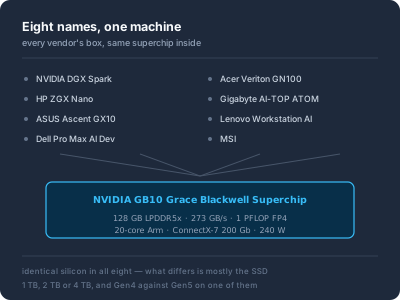
The eight names
| you may have seen | it is |
|---|---|
| NVIDIA DGX Spark | NVIDIA's own box, the reference design |
| HP ZGX Nano AI Station | HP's, model G1n |
| ASUS Ascent GX10 | ASUS's |
| Dell Pro Max with NVIDIA AI Dev | Dell's |
| Acer Veriton GN100 AI Mini Workstation | Acer's |
| Gigabyte AI-TOP ATOM | Gigabyte's |
| Lenovo Workstation AI | Lenovo's |
| MSI Next-Level AI Power | MSI's |
And the terms that turn up alongside them, all pointing at the same thing:
- GB10 — the superchip, not a product you buy on its own
- Grace Blackwell — the architecture pairing an Arm "Grace" CPU with a Blackwell GPU on one package
- Blackwell 128 GB — a description, not a product name
- DGX — NVIDIA's product family; DGX Spark is the desk-sized one, not to be confused with rack DGX systems
- Project DIGITS — the pre-launch codename you will still find in older coverage
What is identical, and what is not
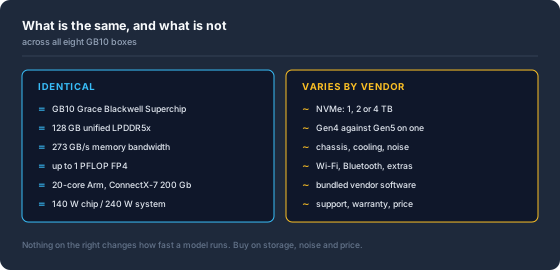
Everything NVIDIA publishes as platform specification is the same in every one of them:
| chip | NVIDIA GB10 Grace Blackwell Superchip |
| memory | 128 GB LPDDR5x, coherent unified CPU+GPU |
| memory bandwidth | 273 GB/s |
| compute | up to 1 PFLOP FP4 |
| CPU | 20-core Arm — 10× Cortex-X925 + 10× Cortex-A725 |
| networking | ConnectX-7 NIC at 200 Gb, plus 10 GbE |
| power | 140 W chip, 240 W system |
The one specification that genuinely varies is storage. ASUS ships the Ascent GX10 from 1 TB, with 2 TB and a 4 TB PCIe Gen 5 configuration above it. HP's ZGX Nano comes in 2 TB and 4 TB. NVIDIA's own DGX Spark goes up to 4 TB. If you are comparing prices and one box looks cheap, check the SSD before concluding anything.
Beyond that, what differs is what always differs between OEM builds of a reference design: chassis, cooling and therefore noise, whether wireless is included, bundled vendor software, and support, warranty and price. Real considerations — none of them change how fast a model runs.
So which one should you buy?
On performance grounds, it does not matter. The silicon is fixed, the memory is fixed, and the bandwidth that governs token generation is fixed at 273 GB/s regardless of whose logo is on the front.
Buy on the things that actually vary:
- Storage, because it is the one spec that differs and the one you cannot change on some units
- Noise, if it lives on your desk rather than in a rack
- Support terms, if it is going into a business
- Price, once the storage tiers are matched — comparing a 1 TB box against a 4 TB box tells you nothing
What one of these actually does
The naming is the easy part. The harder question is whether the machine suits your work, and that we can answer with measurements rather than specifications.
On one box. The 128 GB of unified memory is the entire point: it runs 70B models at 4-bit and 120B-class MoE that a 32 GB desktop card cannot load at all. The cost is bandwidth — 273 GB/s against roughly 1,792 GB/s on an RTX 5090 — so token generation runs at roughly a fifth the speed for models that fit both. We put numbers on that trade in RTX 5090 vs GB10.
On two boxes. Paired over the 200 Gb ConnectX link, we spent a month running three 180B-to-320B flagships across two of them. DeepSeek-V4-Flash measured 71.8 tok/s mean, and retrieval was verified at 835,348 tokens — twelve needles out of twelve. The interconnect turned out to be a non-event: tensor-parallel traffic used 1.3% of the link during decode, so the exotic networking is not what makes the pair work. That write-up is Best Model for a Dual DGX Spark, and it applies to any two of the eight boxes above.
One warning that surprises people. These are not faster than a desktop GPU at everything. Ask a pair to look at images rather than write text and a single RTX 5090 wins by about 2.4× — vision is almost entirely prefill, which is compute-bound, and one 5090 has more compute than two GB10s. Prompt processing and token generation are two different speeds, and this machine is strong at one of them.
The short answer
If you are trying to decide between a DGX Spark, a ZGX Nano, an Ascent GX10 and a Veriton GN100, you are not choosing a computer. You are choosing a case, a warranty and an SSD around a computer that has already been chosen for you.
Related reading
- AI Workstation Comparison: RTX 5090 vs GB10 (HP ZGX) — the capacity-versus-bandwidth trade, measured
- Best Model for a Dual DGX Spark: DeepSeek-V4-Flash vs Qwen3.8-Flash-Next vs GLM-5.3-Flash — a month on two of these boxes
- DeepSeek-V4-Flash on Two GB10s: 304B Params, 1M Context, 83 Watts — what a pair does with a 304B model
- Prompt Processing vs Token Generation: the Two Speeds of an LLM — why bandwidth decides one and compute the other
- Will This LLM Fit My GPU? VRAM Requirements for Every Model Size — the arithmetic behind "128 GB runs what 32 GB cannot"